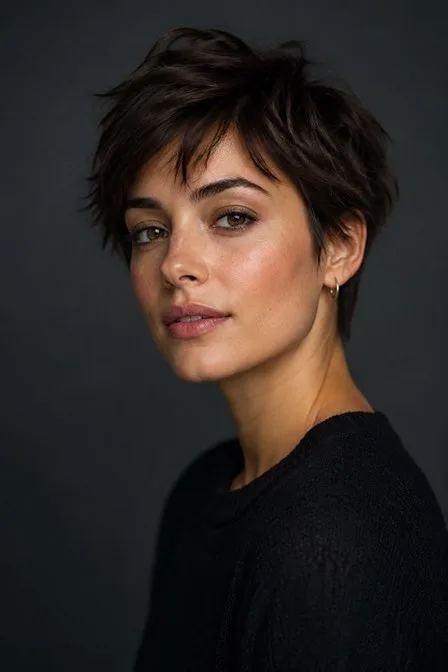
Women's hairstyles
Curtain Bangs
A center-opening fringe that blends into cheekbone or jaw-length layers.
Curtain bangs are longer at the sides than at the center, creating a soft opening around the eyes and cheekbones. They can be subtle, beginning near the nose, or more dramatic with a shorter center. The cut works best when the side pieces connect cleanly into the rest of the haircut instead of sitting as a separate block of fringe.
| Length | Fringe with any overall length |
|---|---|
| Texture | Straight, wavy, or softly curly hair |
| Face-shape starting points | Oval, Heart, Round, Square |
| Maintenance | Medium. Fringe reshaping is often needed every 4 to 8 weeks. |
Who may want to try curtain bangs?
This style is a useful direction for people interested in softening a center part, framing cheekbones, changing a cut without losing length. Face-shape labels are only a starting point; the strongest choice also accounts for density, growth pattern, natural texture, styling time, and how often you want to return for maintenance.
- Softening a center part
- Framing cheekbones
- Changing a cut without losing length
What to ask for at the salon
Ask for a center-opening fringe with the shortest point chosen around your eye or nose level, then blended gradually into cheekbone-length face framing.
Bring a front, side, and back reference when possible. Point to the exact perimeter, fringe position, top height, or side length you want to preserve. Ask the stylist to explain how the idea should be adapted to your real hair rather than copying the image without adjustment.
How to style it
- Dry the fringe forward first, then sweep each side away from the face.
- Use a medium round brush rather than a small brush to avoid a tight curl.
- Reset second-day bangs with a light water mist instead of adding more product.
What to consider before the cut
Strong cowlicks and very humid conditions can change how the center opening sits. Ask the stylist to cut the fringe in its natural fall.
Previewing the silhouette can make the decision clearer, but it cannot predict exact shrinkage, chemical limits, cowlick behavior, or the finish produced by a specific salon technique.