Face shape and hairstyle planning
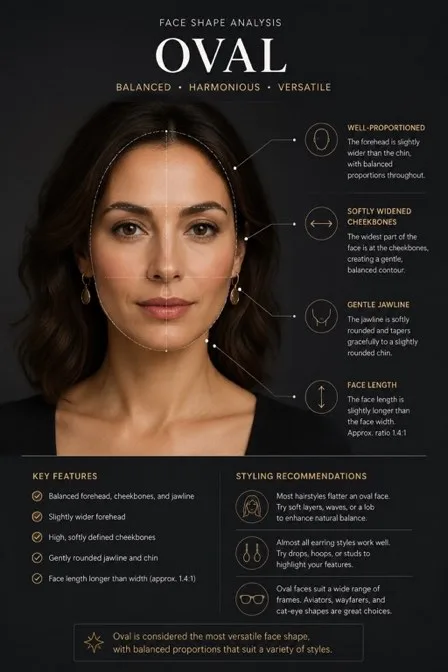
Oval Face Shape
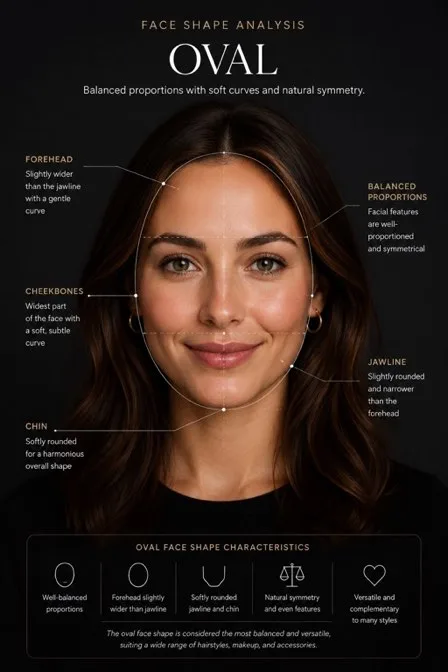
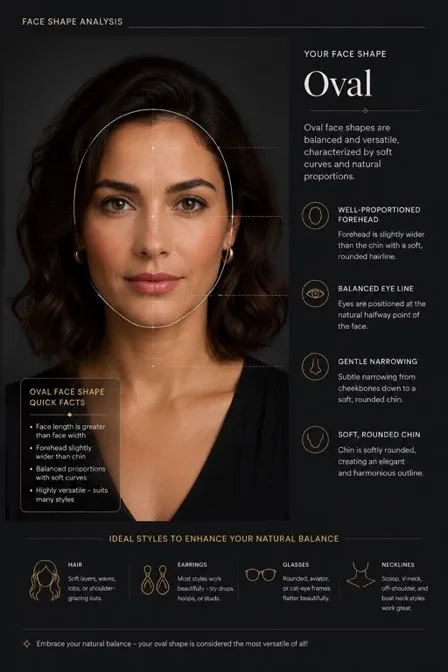
Balanced width with a face length that is moderately greater than the cheekbone width.
An oval face is typically longer than it is wide, with the cheekbones forming the widest area and the forehead and jaw narrowing gently. The jawline usually looks curved rather than strongly angular. Real faces rarely fit one diagram perfectly, so treat oval as a useful description of overall proportion rather than a fixed category.
Common visual clues
- Face length is moderately greater than width
- Cheekbones are often the broadest point
- Forehead and jaw have soft, similar tapering
- Jawline appears rounded or gently curved
Compare total face length with cheekbone width, then look at whether the forehead and jaw taper gradually. Camera distance and lens distortion can alter these proportions.
Hairstyle goals to consider
Face-shape advice is most useful when it explains an effect rather than issuing a rule. Decide whether you want to balance a proportion, soften it, or emphasize it.
- Preserve the natural proportion
- Choose where you want width or height rather than correcting a specific imbalance
- Use fringe, parting, and length to emphasize preferred features
Styles often worth previewing
Blunt lob, Long waves, French bob, Pixie cut, Side part can provide useful starting points for this proportion.
The final choice should also fit hair texture, density, hairline, growth pattern, glasses or facial hair, and the amount of styling and salon maintenance you want.
Details to experiment with
These details are not prohibited. They simply create stronger visual effects, so preview them deliberately:
- Very high crown volume if you do not want extra visual length
- Long, flat styles with no side movement
- Heavy fringe combined with very long straight sides